Evidence status
How often does price revisit a Dark Level? — full study pending
The question and method are published. The full planned study remains incomplete. Separately labeled cohort or pilot results cover only their stated populations and follow-up horizons.
- Method
- Method v1
- Planned window
- First month-end with one year of history to the last month-end at least 60 sessions before the run
- Current evidence
- Full planned result not yet qualified
When the full planned run is qualified, this block will show its date, covered rows and source snapshot. Charts labeled “Illustration on sample data” remain separate from published cohort or pilot results.
Missing inputs for this study
- Historical-as-of Dark Level snapshots paired to each comparison zone.
- Matched zones with a verified 60-session follow-up window.
- Complete follow-up coverage for both the Dark Level and comparison cohorts.
Published result
Research pilot · 100 securities / five follow-up sessions
This bounded result is scoped to the cohort and source snapshot below. It describes the observed sample; it does not complete the broader planned study, predict prices or recommend trades.
Observed in this cohort
- At the five-session horizon, 6 of 423 Dark zones revisited (1.42%) versus 9 of 423 lower-ranked Dark comparison zones (2.13%).
- Coverage
- Oct 15 to Oct 22, 2026
- Cohort
- A deterministic 100-security cohort with ranked Dark zones and lower-ranked Dark comparison zones, frozen at the 2026-10-15 cutoff and followed on 2026-10-16, 19, 20, 21, and 22.
- Securities
- 100
- Zone pairs
- 423
- Rows
- 423
Five-session follow-up
- Dark-zone revisits
- 1.42%6 of 423
- Lower-ranked Dark comparison revisits
- 2.13%9 of 423
Limitations
- Five-session pilot only; 20/60-session rates are censored.
- Snapshot uses cumulative bands with first_day <= cutoff and bucket zones; it is not a full production level-cluster replay.
- Controls are lower-ranked Dark zones (ranks 4-6) from the same snapshot/security/kind, not ordinary controls or production levels.
- Missing closes remain censored; exchange-session calendar is the qualified series day list.
- No causal or predictive claim.
- This is a research-only lower-ranked-Dark-zone pilot, not the full Dark-Level revisit study or a production level result.
- The comparison zones are not ordinary-price controls, and the 20- and 60-session horizons are censored and not reported.
- Ranks are formed within price-band families, so a security can contribute multiple correlated pairs.
Method bands-pit-zones-v2 · reviewed Nov 5, 2026 · 1:21:18 AM ET · source snapshot 991d2531ace4…
Pilot boundary
This narrow five-session pilot compares ranked Dark zones with lower-ranked Dark zones from the same security and snapshot. They are not ordinary-price controls, and the result does not qualify the full Dark-Level revisit question, a production level, or a general market rate.
Follow-up beyond five sessions is censored here: 20- and 60-session rates are not reported. Missing closes remain censored rather than counted as non-revisits, and the pilot makes no causal, predictive, or profitability claim.
Study figure
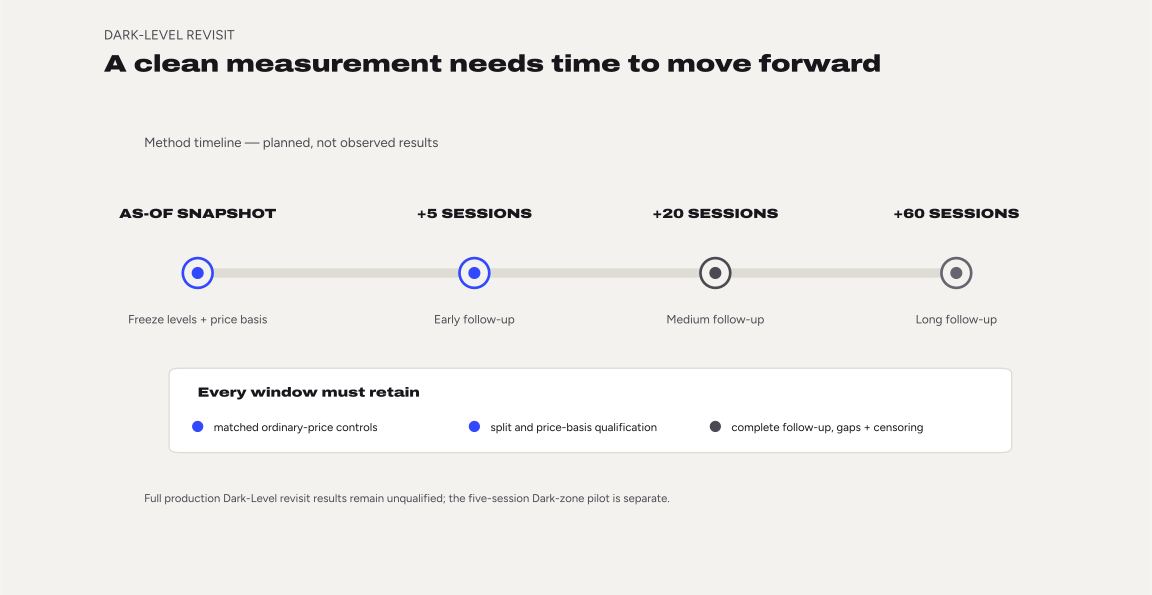
The question
This study measures how often, and how soon, price returns to a
Why it matters to you
The study stops at the Revisit. It records nothing about what price did afterward.
Definitions
- Dark Level.
- A price band where Dark dollar volume built up since 2016, computed only from trades before the start date. Ranks are all-time for this ticker, since 2016, as known on the start date. Band width follows the method version in use.
- Ranked levels.
- The ticker's Dark Levels ranked #1 to #20 on the start date, by all-time rank (Dark dollars since 2016). Level Breaks are timed on these same levels.
- Start date.
- The last regular session of each calendar month.
- Away.
- Price counts as away from a band once a full regular session passes with no trade inside it.
- Revisit.
- The first regular-session trade inside the band after price has been away.
- Comparison zone.
- A band of the same width, at the same distance from the start-date close and in the same direction, placed without regard to Dark volume and not overlapping any Dark Level.
Population, window and eligibility
- Population.
- Covered U.S.-listed stocks and ETFs with at least one year of history at the start date.
- Sample.
- On each start date, each eligible ticker's Dark Levels ranked #1 to #20 that lie outside that day's price range, each paired with one comparison zone.
- Window.
- Start dates from the first month-end with at least one year of history behind it to the last month-end at least 60 sessions before the study runs.
- Eligibility.
- Levels are built under the method version in use, from corrected data. Ticker-sessions with incomplete data are left out, and the report counts them.
What we will measure and how we will report it
- The share of Dark Levels with a Revisit within 5, 20 and 60 sessions of the start date, and the same shares for comparison zones.
- The median number of sessions to the first Revisit, for both.
- Splits by distance from price on the start date, by stocks versus ETFs, and by level rank, with levels ranked #1 to #10 and the all-time top 100 as checks.
Results will appear side by side for Dark Levels and comparison zones. Every figure will show its counts and a 95% interval, and the report will name the method version used and the date the study ran.
Illustration
Sample chart for How often does price revisit a Dark Level?, drawn on made-up data.